AI for SMEs: Practical advice that won’t cost you your business
Outputs from Fry Communication's workshop "Risks, Rewards, and our Robot Overlords"
EDITORIAL AND LONG-FORM COPYWRITINGSTRATEGIC COMMUNICATIONS AND MESSAGING
7/23/20265 min read
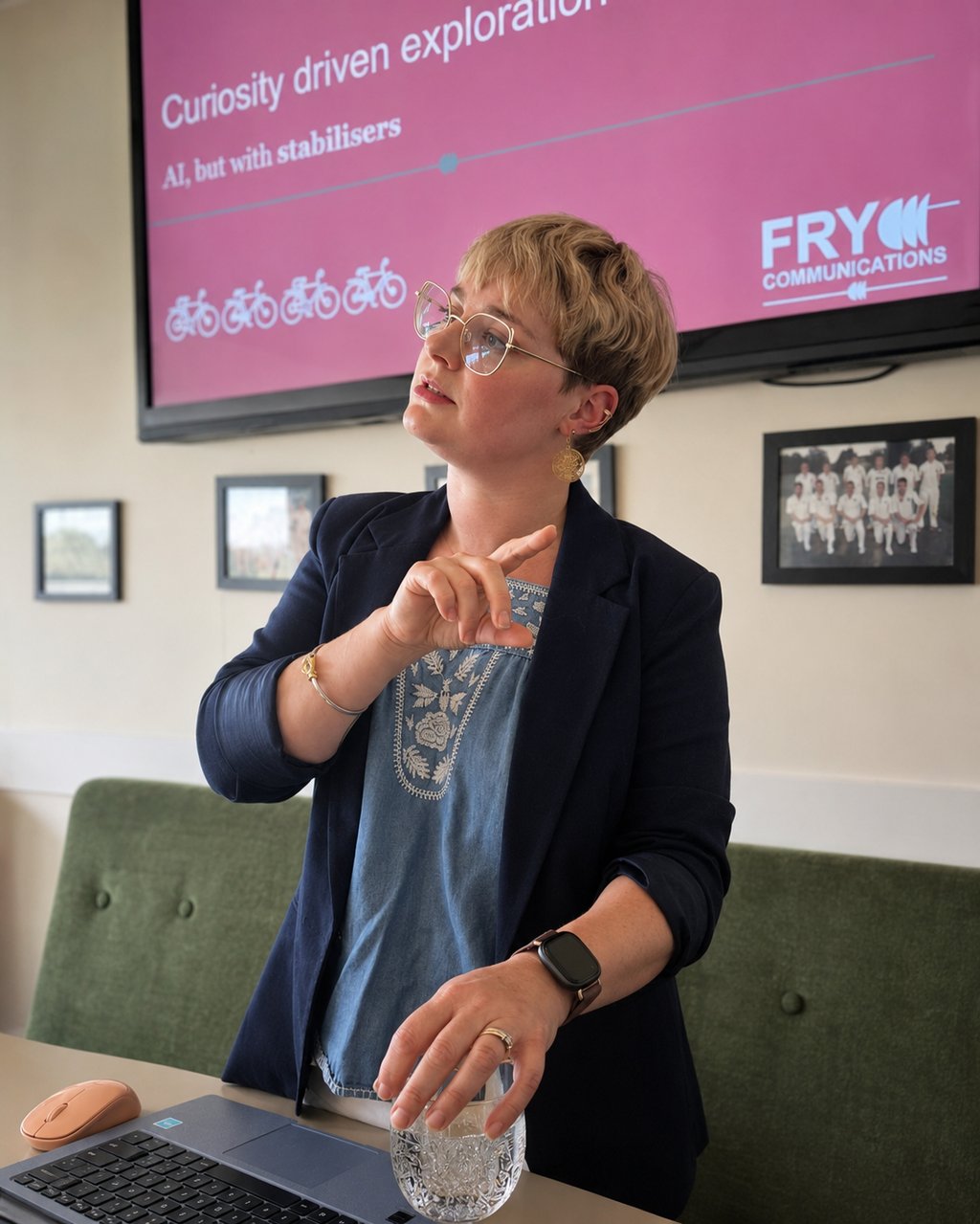
Those who have worked with me know that I love a pun or a bit of wordplay - so of course I had to have a bit of fun with the title of my most recent workshop: "Risks, Rewards, and our Robot Overlords."
It got a few laughs (much to my relief), and set the stage for a great conversation about the world’s current most transformative and controversial technology. Because for something that’s already disrupting nearly every major industry and field in some way or another, AI’s everyday implications for small businesses are surprisingly - dare I say it - simple.
Unlocking capacity without losing what makes SMEs special
Running an SME has always been about wearing many hats. And that’s one of the things I love most about working with small businesses and community organisations. Innovation and problem solving, creativity and resilience, they’re all part of the everyday. Together, they create a brilliant, vibrant and thriving business community.
So my workshop on AI for SMEs isn’t about teaching “what capabilities the AI models have” - it’s showing how dynamically and quickly I’ve seen the business community solve problems that had historically been accepted as “just part of running a business”.
That newsletter that they never had time to write, the website draft that has been in approvals for months, the scribbled ideas on meeting notes that could be the next business development. The opportunity isn’t to get AI to do those jobs, but to pave the way for getting them started. It's buying time to leverage the experience that brought your business to life in the first place, to let it scale in line with your ambition.
AI isn’t a business strategy. It's not your comms team, it's not your new PA. It's another tool, and its value depends entirely on the person using it.
Practical questions small business should be asking about AI usage
AI isn’t coming, it’s already here - and the UK’s small business community is showing up for it in force. According to the British Chamber of Commerce, approximately 35-55% of UK SMEs use AI tools in their businesses, and up to 34% of those who currently aren’t using them are planning to adopt them in the near future. And it's working. Research indicates that those SMEs using AI are seeing productivity increases from 27-133% for specific tasks.
So what does that tell me?
When you look at the type of tasks SMEs are challenging AI to help them with, they fall into three main buckets: marketing and communications, operations and productivity, and customer engagement and sales. These are unsurprisingly some of the most common challenges faced when running a business:
How can I get more customers?
How can I reduce my admin workload?
How can I protect my business?
These are real, practical considerations around risk, policy, and business development - and they show me something really interesting. For most SMEs, AI isn't here to replace “the work” they deliver. It’s doing something far more subtle and valuable. Smart use of AI can give small businesses leverage and more capacity to deliver the work they are uniquely placed to do.
Augmentation over displacement: The real AI opportunity for small business owners
In reality, the biggest challenge when running a small business isn’t a lack of ideas, or professional experience. It's a lack of time and mental capacity. Say you’re switching hats between being an MD, a commissioning editor, an HR manager, and an accountant - sometimes all before lunch. Your time to get to the work that really matters to your business is already limited.
That is the real opportunity. Repetitive, administrative, dare I say awkward tasks that can be time blockers are often very suitable for support from AI, giving some of that headspace back.
I work across a huge variety of sectors, which is one of the biggest benefits of running Fry Communications. And what I see is that each industry and client uses AI differently - but none are using it to do their core business work.
A local plumbing business isn’t building AI agents or automating its customer service - the personal approach is what makes Priory Heating stand out. But they are interested in creating a strong brand visual identity that stands out against other competitors who are relying on generic manufacturers' brand assets.
A solicitor isn’t asking AI to provide legal advice - her real-world experience is vastly more valuable. But she is looking to create engaging, personal visuals and marketing materials with a small set of photography, and a keen drive for client confidentiality and GDPR compliance.
A technology start-up needs to quickly and leanly repurpose technical expertise into newsletters, presentations, and website articles to a diverse stakeholder base - without taking its team away from delivery. A professional coach needs to aggregate engagement trends from email reports from different suppliers - without having to pay for more administration capacity.
Heck, I’ve used it to help me create a professional wardrobe management system so that I can eliminate decision fatigue in the mornings without going down the Steve-Jobs-turtleneck-uniform route.
But each of these applications really centres around removing barriers. Maybe that’s cost, a lack of of professional pictures, or even just having enough time in a day to execute the activities SMEs already are - or know they should be - doing. Used well, AI creates more capacity to delivery their core business, better.
The risks are real
I embrace and encourage my clients to adopt a curiosity-driven exploration of new tools and capabilities with AI and other emerging technologies - but the risks are real. Most of the pieces I read in the media and online swing between two extremes: either AI is going to solve every business problem ever, or it's going to destroy civilisation as we know it.
The truth, for me, probably sits somewhere in the middle. The practical benefits and opportunities are real - they save time and cost. But they’re also not taking humans out of the equation. And the risks I encourage businesses to think about aren't science fiction, either. They're practical!
The most common pitfalls I see? Unknowingly sharing confidential work with public models, ignoring GDPR implications in generated assets, introducing bias into your model or its outputs, copyright infringement and plagiarism - and of course, AI “slop”, the erosion of trust from clients or customers through poor-quality AI-generated content.
These are real issues, with real financial and reputational consequences. So my advice? Set up AI guardrails in your business early, revisit them frequently, and always check your settings.
There are some very simple ways to mitigate risk when using AI. Pay for a professional platform and review all the settings to ensure the right confidentiality levels for your business. Protect your business with policies. You should already have a privacy policy and GDPR statement in place; adding an AI acceptable use policy is a sensible next step. More importantly, make sure those policies are actually followed.
And while AI is a great “first drafter”, always check with your extended network (such as Business Connect Fairford!) to verify work completed outside your own area of expertise. And, of course, cite and check your sources.
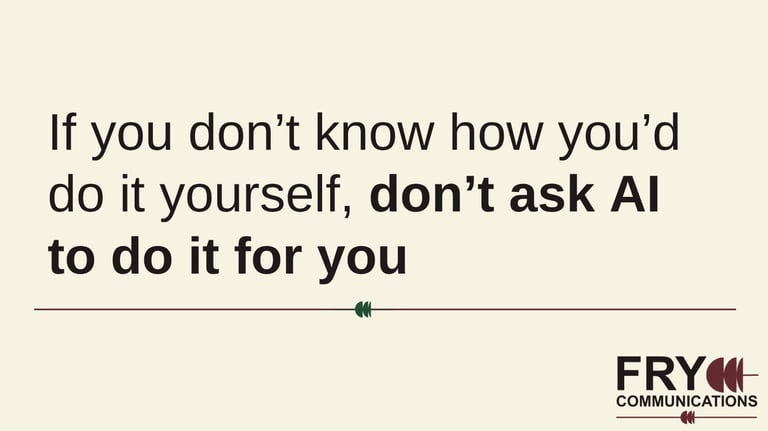
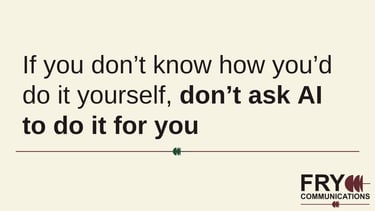
If there was one lesson on mitigating AI risk that I wanted to make sure everyone at the workshop took on, it was this:
If you don't know how you would do it yourself, don't ask AI to do it for you.
If you're interested in a practical introduction to AI for your business, networking group or organisation, I'd be delighted to chat. My workshops focus on practical implementation, sensible governance and helping SMEs use AI confidently without losing the “spark” that makes them successful in the first place.
Director Molly Fry deliverying "Risks, Rewards, and our Robot Overlords at the Fairford Cricket Club